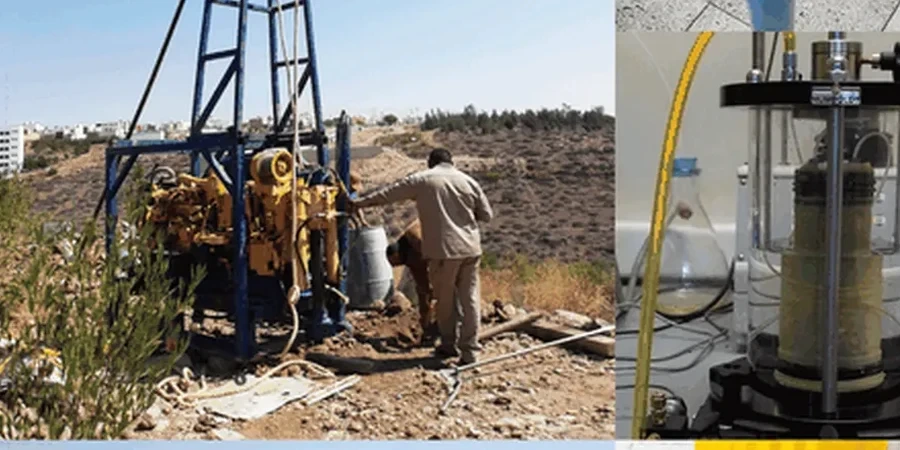
Much of downtown Trenton sits on the Passaic Formation, a mix of interbedded shales and sandstones that weathers into silty, micaceous soils—material that can fool you if you only look at blow counts. On a project near Cadwalader Park, we pulled samples that looked like competent brown silt in the Shelby tube, but consolidation tests showed collapse potential above 4 percent when saturated. That is why a rigorous triaxial program matters here. The Delaware River alluvium along Route 29 adds another layer of variability: loose sands and organic silts that demand careful undisturbed sampling. Whether the site is on residual Piedmont ground or floodplain deposits, the soil mechanics study defines how the foundation will perform over time, not just at 28 days. We run every set with ASTM D4767 for shear strength and ASTM D2435 for consolidation, because in Trenton you do not guess with compressible layers.
In Trenton, the difference between a good sample and a disturbed one is often just a few seconds of mishandling in the split spoon—and that difference changes the foundation design.
Process and scope
The contrast between a site in the redeveloped Chambersburg neighborhood and one out toward Ewing Township illustrates what we deal with daily. Chambersburg, with its history of urban fill over former marshland, often gives us high plastic clays and debris zones—we routinely run Atterberg limits and organic content on those samples because the variability is extreme. Ewing, on the other hand, sits on the Lockatong Formation, producing a leaner, more predictable silty soil that drains better but can still present expansive clay seams in dry summers. Across both areas, our lab runs consolidated-undrained triaxial tests with pore pressure measurement to get effective stress parameters, because total stress analysis alone will miss the behavior of these partially saturated near-surface soils. We also see groundwater within eight to twelve feet in the river-influenced sections, so permeability and consolidation rate become design-critical parameters.
Local ground factors
Trenton's industrial past left a patchwork of fill areas that did not always get compacted to modern standards. The old steel mills and pottery works along the Assunpink Creek corridor deposited slag, ash, and brick fragments that now underlie several residential and commercial parcels. When a developer skips a soil mechanics study in those zones, differential settlement can crack slab-on-grade floors within the first two years. We have also seen sulfate attack on concrete in fill zones where pH and chemical testing were not part of the initial scope. The IBC 2021, adopted by New Jersey, requires a geotechnical investigation per Section 1803 for any structure in Seismic Design Category C or above—and most of Mercer County falls into Category C. That means the soil mechanics study is not optional; it is a code requirement tied directly to the seismic coefficient used in lateral design. Liquefaction potential in the loose alluvial sands near the Delaware is another concern that ties back to our grain-size and relative density data.
Regulatory framework
ASTM D4767 - Consolidated Undrained Triaxial Compression Test for Cohesive Soils, IBC 2021 Section 1803 - Geotechnical Investigations, ASCE 7-22 - Minimum Design Loads and Associated Criteria for Buildings and Other Structures, ASTM D2435 - One-Dimensional Consolidation Properties of Soils Using Incremental Loading, ASTM D4318 - Liquid Limit, Plastic Limit, and Plasticity Index of Soils
Common questions
How much does a soil mechanics study cost for a typical Trenton residential lot?
For a standard single-family home lot in Mercer County, a soil mechanics study that includes drilling, lab classification, and a foundation report typically ranges from US$3.010 to US$5.350. The final number depends on how many borings the site needs, the depth to bedrock, and whether advanced tests like triaxial shear or consolidation are required based on the soils encountered.
What lab tests does the Trenton building department usually require?
The City of Trenton follows IBC 2021, so the minimum is usually a classification suite: moisture content, Atterberg limits, and particle-size distribution with hydrometer. If the site has fill or soft clay, the reviewing engineer will often ask for consolidation and unconfined compression tests. For any structure over three stories, expect a requirement for triaxial shear strength parameters to support the foundation design.
How long does the lab phase take after drilling is complete?
Classification and index tests can be turned around in three to five business days. Consolidation tests need about a week per specimen because of the incremental loading schedule. A full CU triaxial with pore pressure measurement takes seven to ten days. We schedule the lab work to overlap with the drilling so the final report is not waiting on one slow test.
Do you handle the drilling and sampling, or just the lab testing?
We coordinate the entire field and lab sequence. Our drill crew handles the Standard Penetration Testing and Shelby tube sampling, and the samples come directly to our lab the same day. This keeps chain of custody tight and lets us adjust the testing program if the soil turns out different from what the original scope assumed.