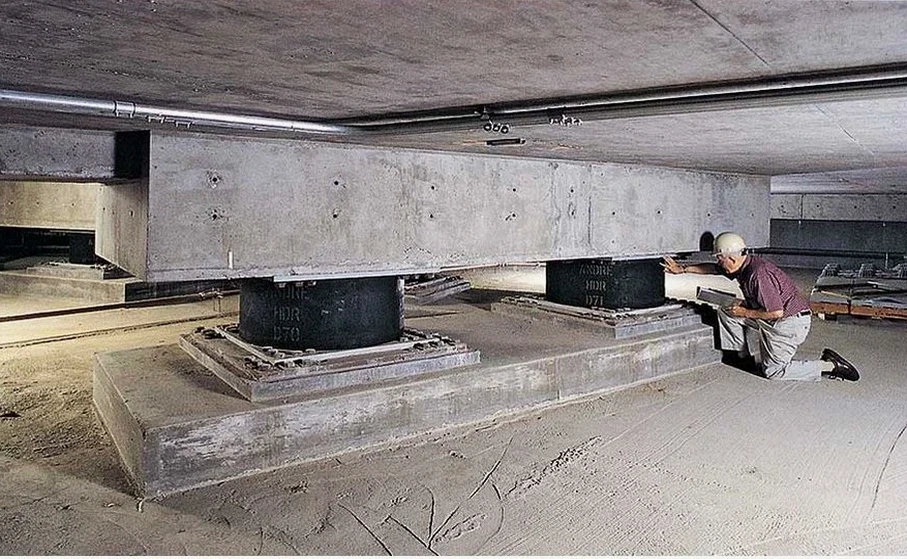
When the truck pulls up to a jobsite near the Delaware River, the first thing you notice is the sheer size of the lead-rubber bearings we handle for base isolation seismic design. Each unit can weigh over a ton, and positioning them correctly above the foundation pedestals takes precision that starts long before installation — back in the lab, when we verify every shear modulus against the design spec. In Trenton, where much of the building stock sits on the Stockton Formation's shale and siltstone, the stiffness contrast between rock and the softer alluvial soils along the Assunpink Creek makes isolator selection a genuinely site-specific exercise, not a catalog pick. We work directly with structural engineers to confirm that the dynamic properties of each isolator match the demands of the local subsurface, because a mismatch here shows up fast during a moderate event.
A well-tested lead-rubber bearing doesn't just reduce acceleration — it buys the structure a predictable recentering capability that saves the nonstructural elements from cumulative drift damage.
Local ground factors
Trenton sits in a Site Class C to D transition zone — the USGS hazard maps place it within 50 miles of the Ramapo Fault system, and while the seismic hazard is moderate, the real risk multiplier here is the combination of aging unreinforced masonry and deep urban fill. We've pulled cores from downtown sites where the first 20 feet are demolition rubble from buildings that were torn down in the 1960s, and that kind of material amplifies ground motion in a 1-2 Hz band that happens to match the fundamental period of a four-to-six story structure. A base isolation system that isn't tested with those site-specific spectral demands can end up with a period that's too close to the soil column's natural frequency, which defeats the purpose. We insist on running the prototype tests using displacement histories derived from the site-specific response spectra, not just the code-minimum, because the difference in cumulative energy dissipated can be on the order of 40% when the soil profile is soft.
Common questions
Does base isolation seismic design actually make sense for a mid-rise building in a moderate seismic zone like New Jersey?
It often does, especially for essential facilities and buildings with expensive nonstructural contents. In Trenton, the governing code is the IBC with ASCE 7-22, and for Risk Category III and IV structures — like hospitals, emergency operations centers, or university lab buildings — base isolation can drop the design base shear enough that you avoid a much more expensive lateral system. The real benefit isn't just lower forces; it's the near-elimination of structural damage and the protection of what's inside the building, which is usually worth more than the frame itself. We've seen the numbers work when the soil profile is soft enough to amplify short-period motion but stiff enough to keep isolator displacements manageable.
What is the typical cost range for base isolation seismic design and testing on a building project in the Trenton area?
For a mid-rise commercial or institutional building in Mercer County, the combined isolator testing program and design-level support typically falls between US$4,730 and US$9,240 for the lab and consulting scope. That covers prototype characterization of two isolator types, production batch testing of a set of bearings, and the geotechnical parameter study to define the site-specific displacement spectra. The cost of the isolators themselves is a separate item handled by the manufacturer.
How do you verify that an isolator will still recenter the building after a major earthquake?
We look at the third-cycle hysteresis loop under Maximum Considered Earthquake displacement. By the third full cycle, any Mullins effect softening in the rubber has stabilized, and the loop area — which is the energy dissipated per cycle — should be consistent. If the effective stiffness at zero displacement on the unloading path is still above the threshold defined by the post-elastic stiffness ratio, the isolator will recenter. We also check the residual displacement after the third cycle; anything above 5% of the maximum displacement triggers a deeper review of the rubber compound and the lead core confinement.
What site-specific data from Trenton do you need before starting isolator prototype testing?
We need the full geotechnical report with SPT or CPT logs down to at least 100 feet or refusal on rock, the shear wave velocity profile — either from downhole, MASW, or crosshole testing — and the site-specific response spectrum from the structural engineer, developed per ASCE 7-22 Chapter 21. If the site is within 500 feet of the Delaware River or the Assunpink Creek floodplain, we also ask for the seasonal high groundwater table elevation, because the effective vertical stress under the isolator pedestals affects the long-term creep behavior of the rubber. With those pieces in hand, we can build the displacement protocol that the lab will run.