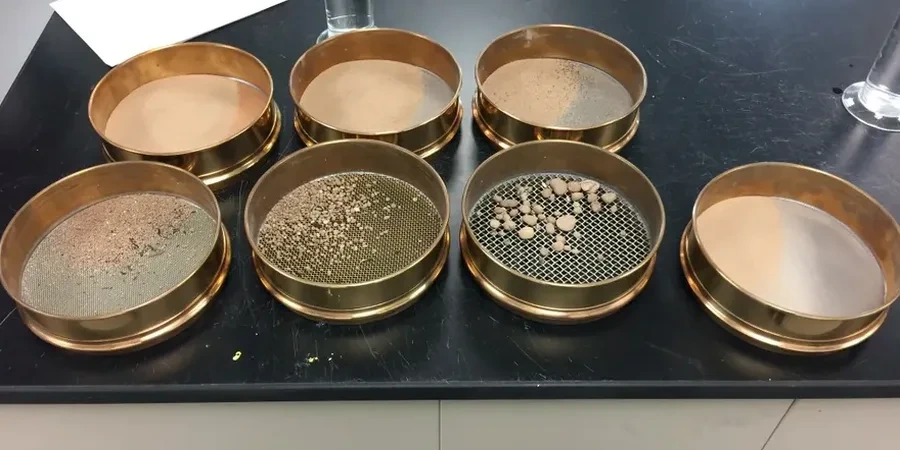
Trenton's industrial past left more than brick landmarks. The city's soil profile is a layered puzzle of Delaware River alluvium, historic fill, and weathered shale from the Stockton Formation. This mix creates a wide particle range that directly governs drainage, frost heave, and bearing capacity. A standard visual classification misses what the grain size analysis reveals through full sieve and hydrometer testing. We run the complete curve, from coarse gravel down to colloidal clay, because foundation design in Mill Hill demands a different approach than compacted fill over in Chambersburg. ASTM D422 and D2487 guide every procedure, and our lab delivers clean gradation reports in 3-4 business days. No shortcuts. Just data that civil and geotechnical engineers can use immediately for specification compliance and earthwork control.
If you skip the hydrometer on a Trenton silt, you're guessing on drainage and missing the fines that control frost behavior.
Process and scope
The contrast between downtown's historic fill and the residual soils near Cadwalader Park is striking. Downtown, you hit brick fragments, ash, and sand lenses above decomposed shale, creating gap-graded curves that complicate compaction. Over by the park, finer silty clays dominate, and the hydrometer portion of the test becomes critical for predicting settlement. Our full
sieve and hydrometer analysis quantifies this difference. The procedure starts with a washed No. 200 sieve split, then mechanical shaking through a stack meeting ASTM E11 requirements, and finally a hydrometer sedimentation reading over 24 hours using a 152H calibrated device. We report D10, D30, D60, and the coefficients of uniformity and curvature, plus the full percent passing table. For Trenton projects near the river, where liquefaction assessment is required, the fines content from this test feeds directly into the
liquefaction analysis and the cyclic resistance ratio calculation.
Common questions
What does a grain size analysis cost in Trenton?
A standard sieve plus hydrometer package runs between $100 and $180 per sample, depending on the number of sieves requested and whether Atterberg limits are added. Volume discounts apply for projects submitting more than ten samples.
How much sample do you need for the test?
We ask for at least 500 grams of dry material for sands and gravels, and about 200 grams for silts and clays. For a combined sieve and hydrometer, a one-gallon bag filled halfway is usually sufficient. The sample must be representative and not oven-dried in the field before delivery.
Why is the hydrometer portion necessary?
The sieve stack stops at the No. 200 mesh, which captures particles down to 75 microns. Everything smaller passes through and is invisible to the sieves. The hydrometer measures the sedimentation rate of those fine silts and clays over 24 hours. Without it, you cannot determine the true fines content, which controls permeability, frost heave potential, and the soil's USCS group symbol.
How fast can I get results for a Trenton project?
Standard turnaround is 3 to 4 business days from sample receipt. The hydrometer sedimentation alone requires a minimum 24-hour reading period for accurate results. For earthwork emergencies, we offer a rush service with results in 24 hours, which includes overnight hydrometer readings and report generation the following morning.
Do you follow NJDOT specifications?
Yes. While our primary test method is ASTM D422, we adapt the procedure to meet NJDOT Standard Specifications for sieve analysis when required. The NJDOT method aligns closely with AASHTO T 88, and we can report in either ASTM or AASHTO format depending on the project's submittal requirements.