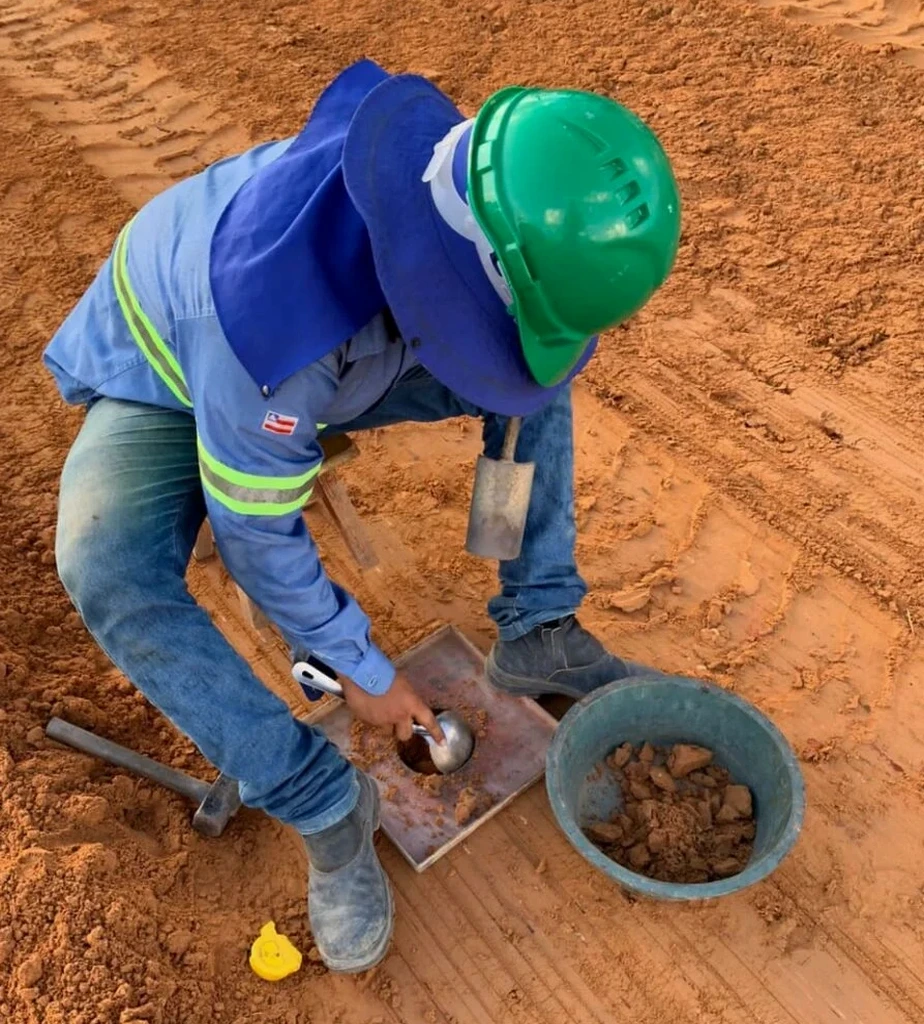
On a recent chilled-cast-iron pipe replacement project near the Delaware River in downtown Trenton, the trench backfill kept failing the proof-roll because the material was being placed in lifts that were too thick for the silty fine sands typical of the Coastal Plain. The contractor was losing a day per block until we brought the sand cone out and started checking each lift against the modified Proctor curve before the plate compactor moved on. That kind of delay is exactly what a disciplined field density testing program prevents. Trenton's mix of historic urban fill, Triassic red beds, and recent alluvium means the lab maximum dry density tells you nothing about what the roller actually achieved unless you verify in-place density at the same elevation and moisture condition where the footing or pavement section will work. We run ASTM D1556 tests with calibrated Ottawa sand and a field balance that gets checked against a known volume every morning, because the margin on a warehouse slab in Chambersburg or a stormwater vault in the West Ward doesn't allow for settlement cracks six months after turnover.
Compaction without field density verification is just an opinion. In Trenton's variable glacial and alluvial soils, the sand cone remains the most defensible method when a nuclear gauge reading gets challenged by the special inspector.
Local ground factors
The single most expensive mistake we see in Mercer County is a contractor placing structural fill directly on undisturbed ground without stripping the topsoil first, then passing density tests on the fill while the organic layer beneath is quietly decomposing and settling. A sand cone test taken at the top of the lift won't catch that problem, which is why the testing sequence matters as much as the test itself. In one case, an Ewing Avenue commercial building started showing diagonal cracks in the CMU walls within 18 months because the geotechnical report called for 95 percent relative compaction, the sand cone results at the surface were hitting 97 percent, but nobody had verified that the lower lifts were compacted before the next lift buried them. We now insist on a lift-by-lift testing schedule for any fill thickness exceeding 18 inches, with a test frequency of at least one per 2,500 square feet per lift or every 150 cubic yards placed, whichever is tighter. The IBC 2021 Chapter 18 and the special inspector's daily report both require that field density documentation tie back to an identifiable station and elevation, and the sand cone log sheet with a hand-drawn sketch of the test location is still the simplest way to meet that standard without GPS drift or software compatibility issues in the city's plan review system.
Common questions
What does a sand cone field density test cost on a typical Trenton commercial project?
The cost for a single ASTM D1556 sand cone density test in the Trenton area typically ranges from US$90 to US$140 per test location, depending on how many tests are performed in one mobilization day and whether the technician needs to transport the sample back to the lab for moisture content determination. A full-day field deployment with 8 to 12 tests and same-day reporting will fall in that per-test range, with mobilization fees applied separately if the site is outside the immediate Mercer County core.
How does the sand cone method compare to a nuclear density gauge for Trenton's soils?
The sand cone method gives a direct measurement of in-place density and moisture content by excavating a small hole and weighing the material removed, while a nuclear gauge infers density from gamma radiation backscatter. In Trenton's older urban fill, which often contains brick fragments, coal ash, and variable organic content, the nuclear gauge can produce readings that are 3 to 5 percent off from the true density because the hydrogen in organic matter affects the moisture measurement. The sand cone avoids that interference entirely, which is why many geotechnical engineers in New Jersey still specify it as the referee method when nuclear gauge results are disputed.
How many sand cone tests are required per lift on a building pad in Trenton?
The IBC 2021 requires a frequency sufficient to ensure that all areas meet the specified relative compaction, and the standard industry practice in New Jersey for a building pad is a minimum of one test per 2,500 square feet per lift. For a 10,000-square-foot pad with 12-inch lifts, that means four tests per lift, with each test taken at a randomly selected location that is documented on a plan sheet. The special inspector may increase the frequency if the material is variable or if initial results show borderline compaction below the specified 95 percent modified Proctor threshold.