← Home · Slopes & Walls

Active/Passive Anchor Design in Trenton, NJ

Together, we solve the challenges of tomorrow.

LEARN MORE →

Trenton's industrial legacy left behind more than just historic mills. The city sits on a complex mix of Delaware River alluvium, glacial outwash, and weathered Brunswick shale. These layers shift under load. When the Route 29 tunnel was widened, crews hit groundwater at 12 feet. We see this pattern across Chambersburg and downtown. Anchors become the only viable solution when space is tight and adjacent buildings can't move. We design tensioned (active) and non-tensioned (passive) anchors that work with the ground, not against it. For sites near the Assunpink Creek, where soft organic silts appear in the upper 8 feet, we often recommend combining anchor systems with a retaining wall analysis to lock in the global stability before excavation starts.

A correctly specified unbonded length in Trenton's shale can reduce anchor creep by 40% over the design life.

Process and scope

IBC 2021 Section 1810 and ASCE 7-22 Chapter 12 govern anchor design in New Jersey. Trenton sits in Seismic Design Category B, but site class varies block by block. Soft clay sites amplify ground motion more than rock. We factor this into every tendon spacing calculation. Our bond length designs follow PTI DC35.1 recommendations. We pull from real site data, not textbook assumptions. A soil resistivity survey helps us specify corrosion protection Class I or II correctly for the site's electrochemistry. In the downtown historic district, where foundations date to the 1890s, we also run a MASW survey to map the Vs30 profile without disturbing the sidewalk. This gives us the exact shear wave velocity needed to finalize the unbonded length and avoid punching through sensitive adjacent footings.
Active/Passive Anchor Design in Trenton, NJ
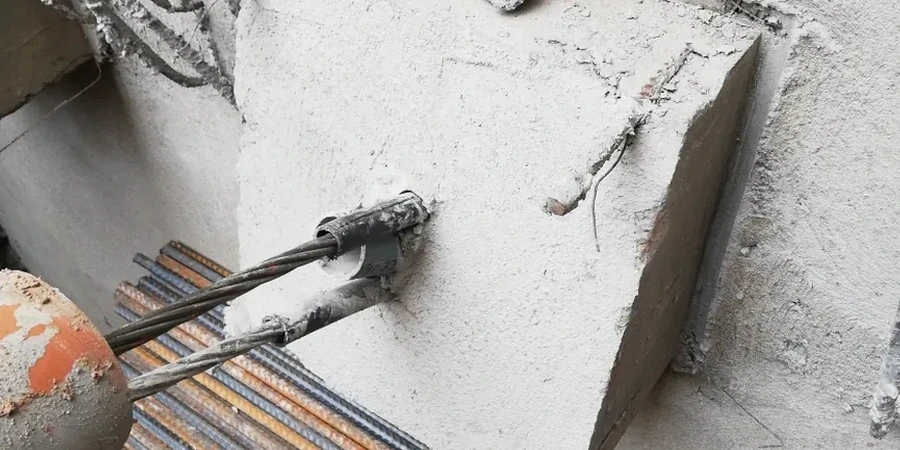
Technical reference image — Trenton New Jersey

Local ground factors

The Delaware River isn't just scenery. It's a groundwater driver. River levels fluctuate 8 feet seasonally. This changes the effective stress in the soil mass behind a wall. A passive anchor system designed for dry conditions in August can be under-designed in March when the river is high. We've seen temporary shoring walls along Route 29 deflect 2 inches during spring thaw simply because the pore pressure regime wasn't modeled for saturation. That deflection translates into cracked utilities and settlement claims. We run multiple groundwater scenarios in our load models. For deep cuts in the alluvial plain south of Lalor Street, we specify active anchors with locked-in loads high enough to counteract the buoyant force, not just the retained earth. This avoids costly remedial grouting mid-construction.

Need a geotechnical assessment?

Reply within 24h.

Email: info@geotechnicalengineering1.sbs

Typical values

ParameterTypical value
Design StandardPTI DC35.1, IBC 2021 1810, ASCE 7-22
Anchor TypeActive (prestressed) and Passive (non-tensioned) bar/strand
Typical Bond Length (Shale)15-25 ft
Typical Bond Length (Alluvium)25-40 ft
Corrosion ProtectionClass I (permanent) or Class II (temporary)
Proof Test Load133% of design load per PTI
Creep Test Duration10 min minimum; extended to 60 min in soft clay

Complementary services

01

Design-Build Anchor Packages

Complete sealed drawings including tendon layout, bond length calculations, corrosion protection specs, and staged stressing sequence.

02

Proof & Performance Testing

On-site load-hold tests. We verify both the grout-ground bond and the tendon-grout bond meet the ultimate capacity with zero movement beyond the elastic limit.

03

Excavation Support Integration

Anchor designs integrated with soldier pile and lagging systems. We coordinate directly with the shoring contractor to match the anchor inclination with the pile spacing.

Regulatory framework

IBC 2021 Section 1810 (Anchors), ASCE 7-22 Chapter 12 (Seismic), PTI DC35.1 (Post-Tensioning Institute), ASTM A615 / A722 (Steel), ASTM D1586 (SPT)

Common questions

What's the difference between active and passive anchors?

Active anchors are tensioned to a locked-in load after installation. They pre-compress the soil mass and limit movement before excavation proceeds. Passive anchors develop resistance only when the wall starts to move. We select based on allowable deflection. In Trenton's historic districts with fragile masonry neighbors, active anchors are usually mandatory.

What do anchor design services cost in Trenton?

Design fees for a typical anchored wall run between US$1,130 and US$3,770 depending on wall height, number of anchor rows, and whether we're handling the submittal to the city engineer directly.

How deep do you drill for anchors in the Trenton shale?

We aim to socket the bond zone 15 to 25 feet into competent shale, which usually sits 20 to 35 feet below street grade in downtown Trenton. We use air rotary or duplex drilling to get through the overburden without collapsing the hole.

Do you handle the special inspection requirements?

Yes. IBC 1705 requires special inspection for anchor installation and testing. Our team performs the proof tests, logs the creep data, and signs off on the inspection reports for the building department.
Location and service area

We serve projects in Trenton New Jersey and surrounding areas.

View larger map