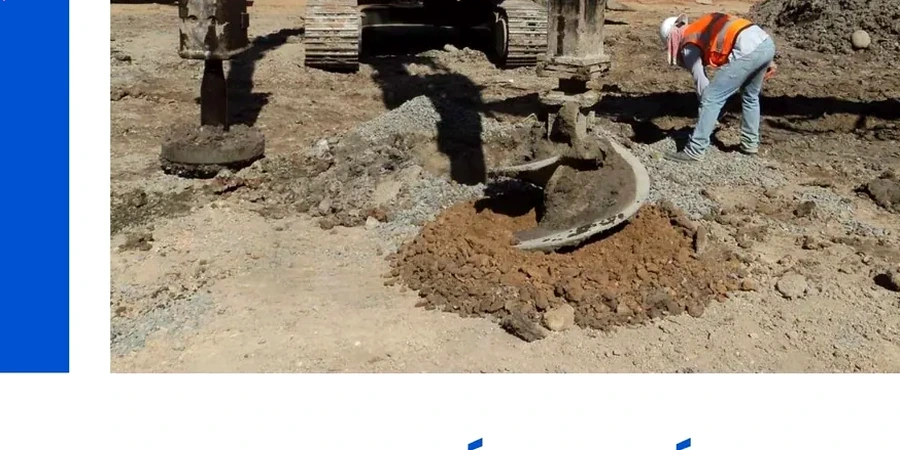
The design of stone columns in Trenton, New Jersey, must directly address the challenging ground conditions found throughout Mercer County, particularly the compressible alluvial deposits and urban fill that line the Delaware River corridor. Under ASCE 7 and the New Jersey edition of the IBC, ground improvement techniques require a detailed geotechnical investigation to quantify settlement potential and bearing capacity failure. Our laboratory, accredited to ISO 17025, processes soil samples from SPT drilling to classify the native material per ASTM D2487. When the SPT N-value drops below 4 in the upper 15 feet—a condition we frequently encounter along the Route 29 industrial belt—stone columns become one of the most economical solutions to transfer structural loads through the soft layer to a more competent bearing stratum beneath. The design process for Trenton’s variable subsurface integrates site-specific modulus values and a thorough review of the regional hydrogeology to prevent construction issues during vibro-replacement.
In Trenton’s Delaware River floodplain, a well-designed stone column grid transforms compressible organic silts into a composite mass dense enough to support heavy manufacturing floor loads without excessive settlement.
Local ground factors
Comparing a project in the Chambersburg neighborhood versus one in the Glen Afton section of Trenton illustrates how drastically the risk profile changes over short distances. Chambersburg sits on loose, saturated alluvium near the Assunpink Creek, where the water table often rises to within three feet of the surface; without stone columns, a shallow footing here would settle unevenly and potentially fail during a flood event. Glen Afton, on higher ground, contains stiffer residual soils that may only require a thinner, less dense column array. The primary risk in the low-lying areas—where stone columns are most needed—is not just static settlement but the potential for liquefaction-induced loss of support during a seismic event, a scenario we analyze using site-specific peak ground accelerations from the USGS Trenton quadrangle. Failing to account for the lateral bulging capacity of the columns in these soft clays, per Priebe’s method, leads to an under-designed grid that cannot contain the radial stresses imposed by a loaded foundation.
Common questions
How much does stone column design cost for a project in Trenton?
For a typical commercial or light industrial project in the Trenton area, the engineering design and quality control plan for a stone column ground improvement program ranges from US$1,560 to US$4,540, depending on the size of the treatment area and the number of design iterations required to optimize the grid spacing.
Does the high water table in Trenton affect stone column installation?
Yes, the shallow groundwater along the Delaware River and Assunpink Creek is a critical factor. The design must specify a bottom-feed vibrator technique to keep the hole open during aggregate placement, and we adjust the column length to ensure the tip is embedded in a stable stratum below the zone of seasonal water level fluctuation.
How do you verify that the stone columns are working as designed?
We perform a post-treatment field testing program, typically combining modulus-based plate load tests directly on the columns with CPT soundings or SPT borings located in the treated soil between the columns. The results are compared against the pre-construction baseline to quantify the actual reduction in void ratio and increase in stiffness.
Can stone columns prevent liquefaction in Trenton’s sandy soils?
Stone columns act as vertical drains and provide densification of the surrounding granular soil through the vibro-replacement process itself. In Trenton’s loose alluvial sands, a properly spaced grid can significantly reduce the buildup of excess pore water pressure during a seismic event, lowering the liquefaction potential index below the threshold that triggers ground failure.