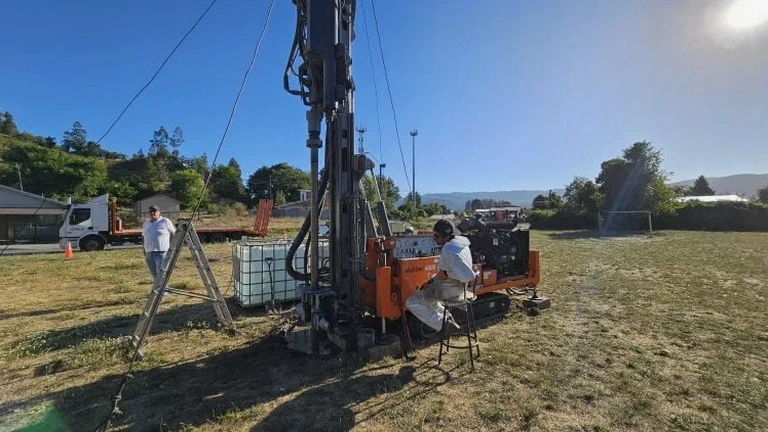
In Trenton, where the Delaware River floodplain and Piedmont geology converge, the first few feet of soil often tell a more complex story than any borehole alone can reveal. Field crews regularly encounter historic fill layers containing brick, ash, and cobble remnants from the city's industrial pottery and steel era, making direct visual examination essential. An exploratory test pit provides that immediate, unmediated window into the subsurface, allowing the geotechnical engineer to assess stratification, identify buried obstructions, and collect undisturbed bulk samples directly from the excavation face. When performed ahead of a CPT test program, test pit data helps calibrate tip resistance readings against actual soil fabric observed in the trench, reducing interpretive uncertainty in the subsequent geotechnical model. Our team follows OSHA Subpart P excavation safety standards on every job, with a registered professional engineer logging the pit walls according to ASTM D2487 classification methods.
A well-logged test pit in Trenton's urban fill reveals depositional history that no split-spoon sample can capture, making it indispensable for shallow foundation design.
Local ground factors
Much of downtown Trenton sits on artificial fill overlying Quaternary alluvium of the Delaware River, a profile that carries significant risk of differential settlement and undocumented obstructions. Historic maps show buried foundations from 19th-century row houses, old utility corridors, and even filled-in mill races that now lie hidden beneath asphalt parking lots and redeveloped parcels. Without direct exposure via an exploratory test pit, these features can go entirely undetected, leading to costly change orders when excavation or pile driving begins. The contact between fill and natural alluvium is often irregular and can trap perched groundwater lenses that standard borings miss if not positioned precisely at that interface. IBC Chapter 18 requires that the soil classification and engineering properties used in foundation design be determined by qualified investigation—visual inspection of a pit face, combined with laboratory index testing, provides the clearest possible evidence for the geotechnical report's recommendations.
Common questions
How much does an exploratory test pit cost in Trenton?
Standard test pit investigation in the Trenton area typically ranges from US$540 to US$780, depending on depth, access constraints, and the laboratory testing suite required. A firm quote is provided after reviewing site plans and confirming the number of pits needed.
What depth can you reach with a test pit in urban Trenton?
Most urban pits reach between 8 and 14 feet using a compact backhoe. Deeper excavation is possible but requires engineered shoring or benching per OSHA Subpart P, which increases the footprint and project duration. We evaluate depth feasibility during the pre-excavation site walk.
What safety measures do you follow during excavation?
All work is executed in strict compliance with OSHA 29 CFR 1926 Subpart P. This includes soil classification for protective system selection, daily competent person inspections, spoil pile setback, and access ladder placement. No personnel enter an unprotected excavation deeper than 5 feet.
Can you collect undisturbed samples from a test pit?
Yes. After the pit face is hand-trimmed, we extract block samples or drive thin-walled Shelby tubes horizontally into the exposed strata. These samples are preserved per ASTM D4220 and transported to the laboratory for strength, consolidation, or permeability testing.
How does a test pit compare to SPT drilling for shallow investigations?
A test pit provides continuous visual exposure of the soil profile, whereas SPT sampling recovers a disturbed sample at discrete intervals. For characterizing urban fill, identifying buried structures, or evaluating shallow bearing strata in Trenton's alluvial soils, a test pit delivers far more detailed fabric and contact information.