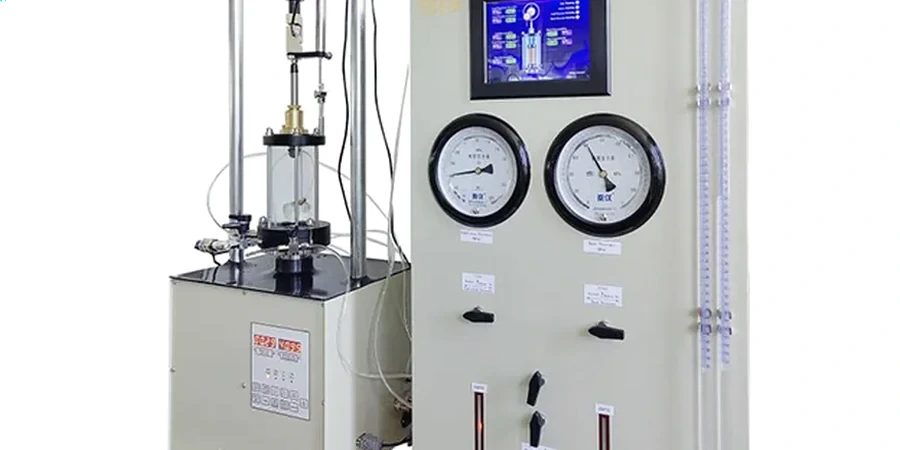
Trenton sits on the fall line where the Piedmont meets the Coastal Plain. That transition creates a mix of diabase bedrock, old alluvium, and compressible silts near the Delaware River. When a project hits those silts, standard SPT blow counts alone won't give the full picture. We run triaxial tests to measure effective stress parameters directly. A consolidated-undrained test with pore pressure measurement tells you exactly how the soil will behave under new loads. For projects near Route 29 or the Trenton-Morrisville Bridge, where fills overlie natural deposits, this data is not optional. It's the difference between a foundation that performs and one that settles unevenly. Many engineers here pair triaxial data with a CPT investigation to correlate tip resistance with undrained shear strength across the site.
A CU triaxial with pore pressure measurement gives you the undrained shear strength and the effective stress envelope in one test sequence.
Common questions
What is the typical cost of a triaxial test in the Trenton area?
The cost for a triaxial test program in central New Jersey ranges from US$1,860 to US$2,380 per test type, depending on the number of confining pressures selected and whether pore pressure measurement is included. A three-stage CU triaxial with back-pressure saturation will be at the upper end of that range.
How long does a triaxial test take to complete?
A CU triaxial test with pore pressure measurement typically takes 7 to 10 business days from sample setup to final report. The consolidation phase alone can require 24 to 48 hours for low-permeability clays. CD tests on fine-grained soils take longer due to the slow strain rate needed to maintain drained conditions.
When should I specify a CU test instead of a UU test?
Specify a CU test when you need effective stress parameters (c' and φ') for long-term stability analysis or when the project involves staged construction. UU tests provide total stress parameters only and are suitable for short-term, end-of-construction conditions where no drainage occurs.
What sample quality is required for a reliable triaxial test?
Undisturbed samples collected in thin-walled Shelby tubes per ASTM D1587 are the standard. The sample must be sealed immediately, transported without vibration, and extruded in the lab under controlled conditions. Disturbed or remolded samples can be used for CD tests on granular soils if the target field density and moisture content are known.