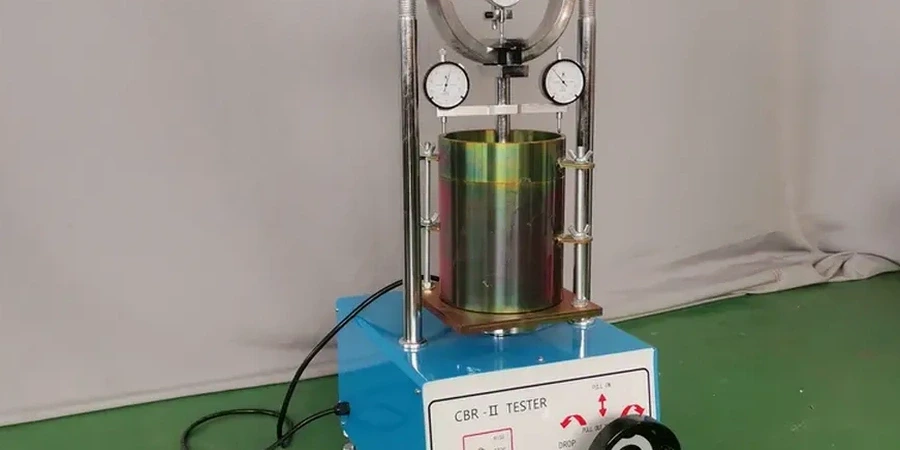
We recently reviewed a warehouse expansion off Route 129 where the contractor was ready to pour, but the existing ground was a mix of urban fill and decomposed shale. They needed a number, not a guess. The Laboratory CBR test gives you that number, measuring the penetration resistance of your subgrade soil under soaked conditions that simulate the worst weeks of a New Jersey winter. In a city like Trenton, with its tight water table and industrial legacy soils, skipping this step means gambling on your asphalt budget. We run these tests to ASTM D1883 and AASHTO T 193 standards, delivering a soaked CBR value that feeds directly into your structural pavement design. It is the difference between a section that lasts 20 years and one that fails after two freeze-thaw cycles. For a complete geotechnical picture in downtown redevelopment zones, we often pair the CBR with grain size analysis to confirm fines content, especially when silt pockets appear in the boring logs.
A soaked CBR value under 3% in Trenton means you're designing for a flexible pavement thickness that can easily exceed 12 inches of aggregate base—knowing that early prevents crushing change orders later.
Process and scope
Trenton sits right on the Fall Line, where the hard bedrock of the Piedmont drops into the coastal plain. That means your site can transition from weathered Wissahickon schist to soft alluvial clay within a hundred feet. The laboratory CBR test becomes essential because these two materials respond completely differently to saturation. Our lab uses automatic loading frames with calibrated load rings to apply the standard 0.05 inches per minute penetration rate, recording effort at 0.1-inch increments up to 0.5 inches. We then soak the compacted sample for 96 hours to simulate long-term field moisture, which is critical given Mercer County's average annual precipitation of 48 inches. Swell potential is measured during this soak, and that number often dictates whether you need lime stabilization. For deep fill areas near the Delaware River, we also recommend vibrocompaction to densify granular layers before starting structural section design, since a low CBR at the top means nothing if the lower lifts are loose river deposits.
Local ground factors
The loading frame in our Trenton lab is a motorized screw-jack unit with a 10,000-pound capacity, equipped with a digital load cell that reads to one-hundredth of a pound. That precision matters because the force difference between a 5% CBR and a 3% CBR at 0.1 inches of penetration is only about 150 pounds on the plunger. When a contractor skips the lab test and tries to correlate CBR from a pocket penetrometer in the field, they miss the saturation effect entirely. The soil in Trenton's East Ward, for example, can look firm when dry but loses over 60% of its bearing capacity when the water table rises in March. Our soaked test replicates that worst-case scenario. Ignoring it leads to under-designed pavements that rut within the first year, triggering warranty claims and expensive mill-and-fill repairs that could have been avoided with a single, properly run laboratory test.
Common questions
How much does a laboratory CBR test cost in Trenton?
A single-point soaked CBR test typically runs US$110 to US$180 per specimen, depending on the number of compaction points and whether you need swell monitoring. A full three-point curve with Proctor correlation will be at the higher end of that range. We provide a firm quote before any work starts, and there are no hidden surcharges for rush reporting.
Do I need a field CBR test or a laboratory CBR test?
For pavement design in New Jersey, the laboratory soaked CBR is the standard—NJDOT specifications reference it directly. Field CBR tests are quick checks during construction but don't account for saturation. The lab test runs 96 hours of soaking, which simulates the subgrade's weakest condition and gives you the conservative design value your pavement engineer needs.
What soil type is the CBR test valid for in Trenton?
The ASTM D1883 method works for cohesive and granular soils with maximum particle sizes up to 3/4 inch. If your site has larger gravel or cobbles—common in Delaware River terrace deposits—we recommend running a gradation first and potentially replacing oversized particles in the lab mold. For pure coarse aggregates, a different test setup may apply.
How long does it take to get results?
The physical test runs four days for the soak period, plus one day for compaction and penetration. We typically deliver a signed, stamped report within 7 business days of sample receipt. If you are on a tight construction schedule, let us know and we can expedite the reporting without cutting corners on the soak time.
What CBR value does NJDOT require for flexible pavement?
NJDOT typically requires a minimum soaked CBR of 5% for the subgrade layer under flexible pavements for low to medium traffic roads. For heavy truck traffic or interstate facilities, they often look for 10% or higher in the upper 12 inches of subgrade. If your native soil falls below that, the specification allows for subgrade treatment or a thicker aggregate base course—our test report gives you the number to justify that design decision.